Riassunto puntate precedenti:
Una chiacchierata su questo articolo:
Il Deserto, un Alleato Potente: Quando Dio ci Parla nel Silenzio
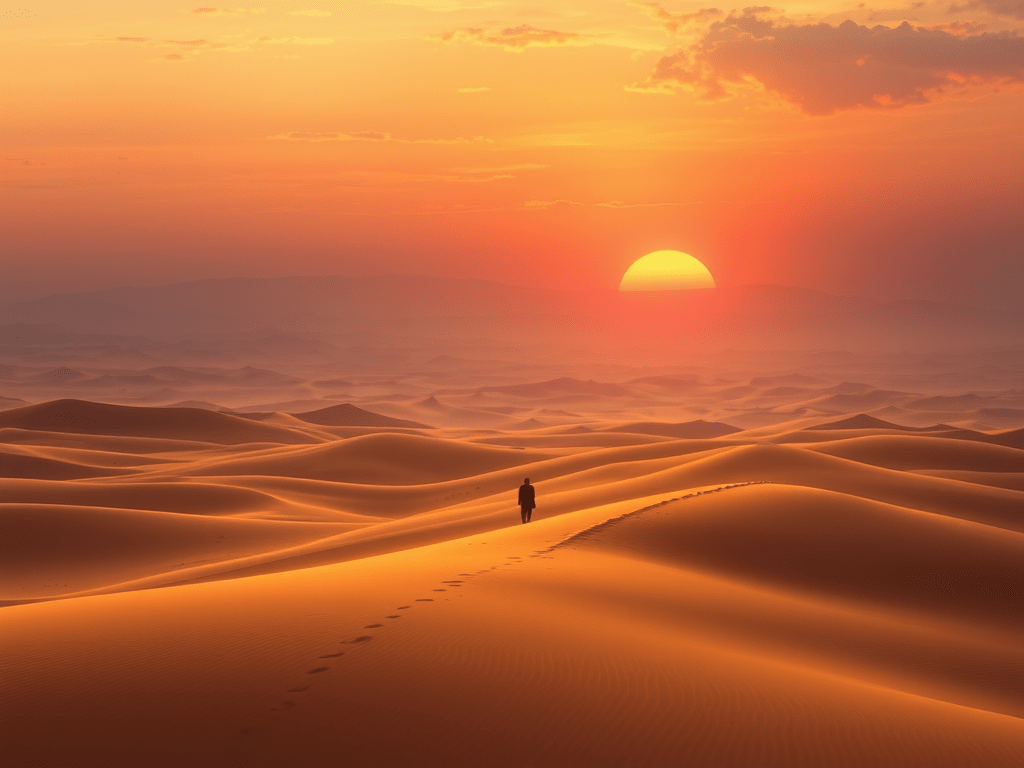
Quante volte nella mia vita ho attraversato periodi che posso definire solo come “deserto”? Momenti di aridità spirituale, di solitudine relazionale, di crisi lavorativa o familiare che mi hanno fatto sentire come se camminassi su sabbie infinite senza vedere l’orizzonte. In questo periodo della mia vita ne sto attraversando proprio uno. È come se davvero non riuscissi a vedere che poche aree di oasi nella mia vita, in un mare di vuoto e povertà. Mi è spontaneamente venuto da chiamare questo spazio un deserto. Ho notato però una differenza rispetto al passato. Un particolare che fa tutta la differenza del mondo. Ho pensato “non sono solo”. E questo pensiero l’ho potuto mettere a fuoco solo qui, solo ora, nel deserto. Questi deserti allora non sono maledizioni, ma alleati potenti nella mia crescita spirituale.
Il Deserto esistenziale
Il deserto che conosco, che forse anche voi conoscete, è quello esistenziale. È quel senso di vuoto quando le relazioni sembrano svuotarsi di significato, quando il lavoro diventa precario e incerto, quando la famiglia attraversa crisi che sembrano insormontabili.
È un momento che si presenta non voluto spesso, potrebbe sembrare un incidente di percorso, ma forse non lo è. Potrebbe essere un tempo di passaggio che dovremmo addirittura augurarci.
San Giovanni della Croce, nel suo capolavoro mistico La Notte Oscura dell’Anima, descrive proprio questa esperienza come una purificazione passiva necessaria. “Per arrivare a gustare tutte le cose, devi rinnegare tutte; per arrivare a possedere tutte, devi distaccarti da tutte”, scrive il santo carmelitano. Non è masochismo spirituale, ma saggezza profonda: il deserto ci spoglia del superfluo per darci l’essenziale.
A volte il deserto diventa anche un deserto spirituale, un deserto di fede, dove sembriamo perdere anche il riferimento della fede.
Possiamo scoprire la fede vera nel deserto, proprio vedendo vacillare e cadere quella posticcia, quella delle convinzioni superficiali.
Il Catechismo della Chiesa Cattolica, ai numeri 2730-2731, conferma questa intuizione quando parla dell’aridità spirituale come prova della fede. Non è Dio che si allontana da noi, siamo noi che veniamo purificati dalle false sicurezze. San Tommaso d’Aquino, nella sua monumentale Summa Theologica (II-II, q. 108, a. 3), va oltre: le tentazioni e le prove del deserto sono mezzi attraverso cui la carità viene purificata, rendendo l’anima più essenziale e unita a Dio.
La Pedagogia Divina del Deserto nella Storia della Salvezza
Nella Scrittura, il deserto emerge come un protagonista silenzioso ma potente della storia della salvezza. Il popolo d’Israele trascorse quarant’anni nel deserto dopo l’uscita dall’Egitto. Non fu una punizione, ma una formazione. Il Deuteronomio (8,2-3) ce lo rivela chiaramente: “Ricordati di tutto il cammino che il Signore tuo Dio ti ha fatto percorrere in questi quarant’anni nel deserto, per umiliarti e metterti alla prova, per sapere quello che avevi nel cuore”.
È nel deserto che Israele impara la dipendenza totale da Dio: la manna dal cielo (Es 16), l’acqua dalla roccia (Es 17), la colonna di fuoco e di nube che guida il cammino (Es 13,21-22). Ogni miracolo nel deserto è una lezione sulla Provvidenza divina, un invito a fidarsi completamente del Signore quando tutto sembra perduto.
Ma il deserto biblico raggiunge il suo apice con Gesù stesso. Dopo il battesimo nel Giordano, “lo Spirito lo sospinse nel deserto” (Mc 1,12). Quaranta giorni e quaranta notti di digiuno, tentazioni, solitudine. Eppure, è proprio lì che Cristo ci mostra come vincere: con la Parola di Dio. Ad ogni tentazione del diavolo, risponde con la Scrittura: “Non di solo pane vivrà l’uomo, ma di ogni parola che esce dalla bocca di Dio” (Mt 4,4).
Il profeta Osea ci svela poi il segreto più intimo del deserto: “Perciò, ecco, io la sedurrò, la condurrò nel deserto e parlerò al suo cuore” (Os 2,16). Il deserto non è il luogo dell’abbandono, ma del corteggiamento divino. È lì che Dio può finalmente parlare al nostro cuore, quando il rumore del mondo tace.
La Saggezza dei Padri del Deserto: Maestri di Essenzialità
Nel III e IV secolo, mentre l’Impero Romano si cristianizzava superficialmente, migliaia di uomini e donne fuggirono nei deserti d’Egitto, Palestina e Siria. Non fuggivano dal mondo per disprezzo, ma cercavano Dio nell’essenzialità più radicale.
Sant’Antonio il Grande, padre del monachesimo, passò vent’anni in solitudine assoluta nel deserto. I suoi Apophthegmata (detti) sono perle di saggezza: “Colui che siede nel deserto e pratica la quiete è liberato da tre guerre: quella dell’udito, quella della lingua e quella della vista; gliene resta una sola: quella del cuore”. Il deserto diventa così il laboratorio dove si combatte la vera battaglia spirituale, quella interiore.
Abba Arsenio, uno dei più venerati Padri del Deserto, ricevette da Dio tre parole che divennero il suo programma di vita: “Fuge, tace, quiesce” – fuggi, taci, sta’ in pace. Non è misantropia, ma minimalismo spirituale portato alle estreme conseguenze. Nel silenzio del deserto, l’anima impara a distinguere la voce di Dio dal rumore delle proprie passioni.
Evagrio Pontico, discepolo di questi giganti spirituali, sistematizzò l’esperienza del deserto identificando gli otto pensieri malvagi (logismoi) che assalgono il monaco: gola, lussuria, avarizia, tristezza, ira, accidia, vanagloria e superbia. Questa lista, ripresa e perfezionata da San Gregorio Magno, diventerà la base della dottrina sui sette vizi capitali che il Catechismo (n. 1866) ancora oggi propone.
San Benedetto, nella sua Regola, cita continuamente “i detti e i fatti dei santi Padri” come fonte di sapienza monastica. Al capitolo 73, li raccomanda come lettura essenziale per chi vuole progredire nella vita spirituale. Non è nostalgia archeologica, ma consapevolezza che questi Padri hanno mappato il territorio spirituale del deserto per noi.
I Santi: Testimoni Viventi della Fecondità del Deserto
Ho scoperto che esistono le Lettere dal Deserto di Fratel Carlo Carretto. Questo piccolo fratello di Charles de Foucauld scrive dal Sahara parole che mi hanno fatto riflettere profondamente: “Il deserto è il luogo dove Dio ci spoglia per darci se stesso”. Non è teoria astratta, ma esperienza vissuta sulla propria pelle sotto il sole implacabile del Sahara.
Santa Teresa d’Avila, Dottore della Chiesa, nel suo Castello Interiore descrive periodi di aridità spirituale così intensi da farle dubitare della presenza di Dio. Eppure, è proprio attraversando questi deserti che scopre le “seste dimore”, dove l’anima sperimenta il fidanzamento spirituale con Cristo. “Sua Maestà”, come lei chiamava affettuosamente il Signore, si rivela paradossalmente più presente nell’assenza apparente.
San Giovanni della Croce, compagno di riforma di Teresa, va ancora più in profondità. La sua “notte oscura” non è depressione spirituale, ma opera chirurgica di Dio sull’anima. Nel Cantico Spirituale (strofa 3), l’anima grida: “Dove ti nascondesti, Amato, lasciandomi nel gemito?”. Ma è proprio questa ricerca appassionata nel deserto dell’assenza che prepara l’unione trasformante.
San Serafino di Sarov, gigante della spiritualità ortodossa russa, visse per anni su una roccia nel deserto della foresta, in preghiera continua. Quando gli chiesero come potesse sopportare tale solitudine, rispose: “Non sono solo, sono con Dio”. Il deserto gli aveva insegnato che la vera solitudine non è assenza di compagnia umana, ma presenza della compagnia divina.
Sant’Efrem il Siro, la “cetra dello Spirito Santo”, cantava: “Beato sei tu, o uomo che porti i tuoi passi nel deserto, perché là troverai il Dio di Giacobbe”. Non è masochismo, ma realismo spirituale: nel deserto, strappate tutte le maschere, l’anima si trova faccia a faccia con il suo Creatore.
Charles de Foucauld, il “fratello universale”, scoprì la sua vocazione proprio nel deserto del Sahara. Scriveva: “Non appena ho creduto che c’era un Dio, ho capito che non potevo fare altro che vivere per Lui”. Il deserto gli aveva insegnato l’essenziale: Dio basta.
La Teologia del Deserto: Via Purgativa verso l’Unione
San Bonaventura, nel suo Itinerarium Mentis in Deum, descrive il cammino spirituale come un’ascesa che passa necessariamente attraverso la via purgativa. Il deserto è il primo gradino di questa scala mistica: spogliazione dei sensi per elevarsi alla contemplazione. Non è disprezzo del creato, ma purificazione dello sguardo per vedere Dio in tutte le cose e tutte le cose in Dio.
La scolastica medievale, integrando Aristotele con la rivelazione biblica, comprese che il deserto non è contro natura, ma secondo una natura più profonda. San Tommaso d’Aquino insegna che la perseveranza nelle aridità spirituali è espressione della virtù teologale della speranza, che “tende a Dio appoggiandosi al suo aiuto” (Summa Theologica, II-II, q. 17, a. 1).
Papa Benedetto XVI, nella sua enciclica Deus Caritas Est, tocca questo tema quando parla delle “purificazioni e maturazioni” necessarie all’amore. Il deserto è pedagogia divina, scuola dove l’eros viene trasfigurato in agape, l’amore possessivo in amore oblativo.
Papa Francesco, con la concretezza che lo caratterizza, in un’omelia del 2021 disse: “Dio abita i nostri deserti esistenziali”. Non è consolazione a buon mercato, ma verità teologica profonda: il Dio cristiano non fugge i nostri deserti, li abita, li trasfigura dall’interno.
Il Catechismo (n. 2015) è lapidario: le prove spirituali, i deserti dell’anima, sono essenziali per la santità. Non accessori opzionali per mistici di professione, ma tappe necessarie per ogni battezzato che prenda sul serio la propria vocazione alla santità.
Il Mio Deserto, il Nostro Deserto: Un Invito alla Speranza
Mentre scrivo queste righe, ripenso ai miei deserti personali e a quello presente. Non si tratta di momenti di per sé piacevoli. Tutt’altro. Momenti in cui se mi ricordo la preghiera questa sembra rimbalzare sul soffitto.
Diciamo, nel deserto ci si sente soli. Eppure, come accade nei bei film, è sempre possibile un finale a sorpresa. Nel mio blog ho parlato allo sfinimento del punto zero. Sembra che io voglia sempre tornare a parlarne, ma il deserto ci mette proprio in un “punto zero” naturale. Un luogo dove siamo soli, presenti soltanto a noi stessi. E indovinate quale è il punto migliore per incontrare Dio?
Proprio lì. Proprio qui, in mezzo a quella che fino a un minuto fa sembrava la mia miseria.
Il deserto ci insegna il minimalismo spirituale: quando tutto il superfluo è stato bruciato dal sole implacabile della prova, resta solo l’essenziale – la fede nuda, la speranza contro ogni speranza, la carità purificata. È un laboratorio divino dove la nostra fede viene testata non per essere distrutta, ma per essere raffinata come l’oro nel crogiolo.
Nel nostro deserto – perché so che molti di noi lo stanno attraversando mentre leggono, mi ascoltano o mi vedono – vi invito a non fuggire. State. Perseverate. Pregate anche quando sembra inutile. Leggete la Scrittura anche quando sembra muta. Invocate i santi anche quando il cielo sembra di bronzo.
Ricordate le parole di Isaia che hanno sostenuto generazioni di credenti nel deserto: “Ecco, io faccio una cosa nuova: proprio ora germoglia, non ve ne accorgete? Aprirò anche nel deserto una strada, immetterò fiumi nella steppa” (Is 43,19). Il Dio che ha fatto scaturire acqua dalla roccia per Israele, che ha nutrito Elia nel deserto, che ha sostenuto Gesù contro le tentazioni, è lo stesso Dio che cammina con voi nel vostro deserto.
Il deserto non è la fine della storia, ma l’inizio di una storia nuova. È il luogo dove Dio ci spoglia delle false sicurezze per rivestirci di Sé stesso. È il crogiolo dove la fede da nozione diventa esperienza, dove la speranza da sentimento diventa roccia, dove l’amore da emozione diventa decisione.
Sant’Agostino, che di deserti interiori se ne intendeva, scrisse nelle Confessioni: “Ci hai fatti per Te, Signore, e il nostro cuore è inquieto finché non riposa in Te”. Il deserto è proprio questa inquietudine portata all’estremo, fino a quando non resta che Dio come unica oasi, unica sorgente, unica patria.
Dal Salmo 63: “O Dio, tu sei il mio Dio, all’aurora ti cerco, di te ha sete l’anima mia, a te anela la mia carne, come terra deserta, arida, senz’acqua”.
Paradossalmente, è proprio quando siamo terra deserta che possiamo accogliere più profondamente l’acqua viva dello Spirito. Il deserto non è maledizione, è benedizione nascosta. Non è tomba, è grembo. Non è fine, è inizio.
Che siano benedetti i nostri deserti e che la fede li trasformi in giardini fioriti.
Il deserto è un alleato potente. Fidatevi: ne vale la pena.
ENGLISH
The Desert, a Powerful Ally: When God Speaks to Us in Silence
How many times in my life have I gone through periods that I can only describe as a “desert”? Moments of spiritual aridity, of relational solitude, of work or family crisis that made me feel as if I were walking on infinite sands without seeing the horizon. In this period of my life, I am going through one right now. It’s as if I can truly see only a few oasis areas in my life, in a sea of emptiness and poverty. It came naturally to me to call this space a desert. I noticed, however, a difference compared to the past. A detail that makes all the difference in the world. I thought “I am not alone.” And I was able to focus on this thought only here, only now, in the desert. These deserts, then, are not curses, but powerful allies in my spiritual growth.
The Existential Desert
The desert I know, which perhaps you also know, is the existential one. It is that sense of emptiness when relationships seem to empty of meaning, when work becomes precarious and uncertain, when the family goes through crises that seem insurmountable.
It is a moment that presents itself unwanted often, it might seem like a mishap along the way, but perhaps it is not. It could be a time of passage that we should even wish for ourselves.
Saint John of the Cross, in his mystical masterpiece The Dark Night of the Soul, describes precisely this experience as a necessary passive purification. “To taste all things, you must renounce all; to possess all things, you must detach yourself from all,” writes the Carmelite saint. It is not spiritual masochism, but profound wisdom: the desert strips us of the superfluous to give us the essential.
Sometimes the desert also becomes a spiritual desert, a desert of faith, where we seem to lose even the reference of faith itself.
We can discover true faith in the desert, precisely by seeing waver and fall that false faith, that of superficial convictions.
The Catechism of the Catholic Church, in numbers 2730-2731, confirms this intuition when it speaks of spiritual aridity as a test of faith. It is not God who distances himself from us, it is we who are purified from false securities. Saint Thomas Aquinas, in his monumental Summa Theologica (II-II, q. 108, a. 3), goes further: the temptations and trials of the desert are means through which charity is purified, making the soul more essential and united to God.
The Divine Pedagogy of the Desert in the History of Salvation
In Scripture, the desert emerges as a silent but powerful protagonist of the history of salvation. The people of Israel spent forty years in the desert after the exodus from Egypt. It was not a punishment, but a formation. Deuteronomy (8,2-3) reveals this to us clearly: “Remember all the way which the Lord your God has led you in the wilderness these forty years, to humble you and test you, to know what was in your heart.”
It is in the desert that Israel learns total dependence on God: the manna from heaven (Ex 16), water from the rock (Ex 17), the pillar of fire and cloud that guides the journey (Ex 13,21-22). Every miracle in the desert is a lesson on divine Providence, an invitation to trust completely in the Lord when all seems lost.
But the biblical desert reaches its apex with Jesus himself. After his baptism in the Jordan, “the Spirit drove him out into the desert” (Mk 1,12). Forty days and forty nights of fasting, temptations, solitude. Yet it is precisely there that Christ shows us how to overcome: with the Word of God. To every temptation of the devil, he responds with Scripture: “Man does not live by bread alone, but by every word that comes from the mouth of God” (Mt 4,4).
The prophet Hosea then reveals to us the most intimate secret of the desert: “Therefore I am now going to allure her; I will lead her into the desert and speak tenderly to her” (Hos 2,16). The desert is not the place of abandonment, but of divine courtship. It is there that God can finally speak to our heart, when the noise of the world is silent.
The Wisdom of the Desert Fathers: Masters of Essentiality
In the III and IV centuries, while the Roman Empire was superficially Christianizing, thousands of men and women fled to the deserts of Egypt, Palestine, and Syria. They did not flee from the world out of contempt, but sought God in the most radical essentiality.
Saint Anthony the Great, father of monasticism, spent twenty years in absolute solitude in the desert. His Apophthegmata (sayings) are pearls of wisdom: “He who sits in the desert and practices quietude is freed from three wars: that of hearing, that of tongue, and that of sight; only one remains: that of the heart.” The desert thus becomes the laboratory where the true spiritual battle is fought, the interior one.
Abba Arsenius, one of the most venerated Desert Fathers, received from God three words that became the program of his life: “Fuge, tace, quiesce” – flee, be silent, be at peace. It is not misanthropy, but spiritual minimalism taken to its extreme consequences. In the silence of the desert, the soul learns to distinguish the voice of God from the noise of its own passions.
Evagrius Ponticus, disciple of these spiritual giants, systematized the experience of the desert by identifying the eight evil thoughts (logismoi) that assail the monk: gluttony, lust, avarice, sadness, anger, sloth, vainglory, and pride. This list, taken up and perfected by Saint Gregory the Great, will become the basis of the doctrine on the seven capital vices that the Catechism (n. 1866) still proposes today.
Saint Benedict, in his Rule, continually cites “the sayings and deeds of the holy Fathers” as a source of monastic wisdom. In chapter 73, he recommends them as essential reading for those who wish to progress in spiritual life. It is not archaeological nostalgia, but awareness that these Fathers have mapped the spiritual territory of the desert for us.
Saints: Living Witnesses to the Fruitfulness of the Desert
I discovered that there are the Letters from the Desert by Brother Carlo Carretto. This little brother of Charles de Foucauld writes from the Sahara words that made me reflect deeply: “The desert is the place where God strips us to give us himself.” It is not abstract theory, but lived experience on one’s own skin under the relentless sun of the Sahara.
Saint Teresa of Avila, Doctor of the Church, in her Interior Castle describes periods of spiritual aridity so intense as to make her doubt the presence of God. Yet it is precisely by crossing these deserts that she discovers the “sixth dwellings,” where the soul experiences spiritual betrothal with Christ. “His Majesty,” as she affectionately called the Lord, reveals himself paradoxically more present in apparent absence.
Saint John of the Cross, companion of Teresa’s reform, goes even deeper. His “dark night” is not spiritual depression, but God’s surgical work on the soul. In the Spiritual Canticle (stanza 3), the soul cries out: “Where have you hidden, Beloved, leaving me in lamentation?” But it is precisely this passionate search in the desert of absence that prepares transformative union.
Saint Seraphim of Sarov, giant of Russian Orthodox spirituality, lived for years on a rock in the forest desert, in continuous prayer. When asked how he could bear such solitude, he answered: “I am not alone, I am with God.” The desert had taught him that true solitude is not the absence of human company, but the presence of divine company.
Saint Ephrem the Syrian, the “harp of the Holy Spirit,” sang: “Blessed are you, O man who directs your steps to the desert, for there you will find the God of Jacob.” It is not masochism, but spiritual realism: in the desert, stripped of all masks, the soul finds itself face to face with its Creator.
Charles de Foucauld, the “universal brother,” discovered his vocation precisely in the Sahara desert. He wrote: “As soon as I believed that there was a God, I understood that I could not do anything but live for Him.” The desert had taught him the essential: God is enough.
The Theology of the Desert: Purgative Way toward Union
Saint Bonaventure, in his Itinerarium Mentis in Deum, describes the spiritual journey as an ascent that necessarily passes through the purgative way. The desert is the first step of this mystical ladder: stripping away the senses to ascend to contemplation. It is not contempt for creation, but purification of sight to see God in all things and all things in God.
Medieval scholasticism, integrating Aristotle with biblical revelation, understood that the desert is not against nature, but according to a deeper nature. Saint Thomas Aquinas teaches that perseverance in spiritual aridity is an expression of the theological virtue of hope, which “tends toward God by relying on his help” (Summa Theologica, II-II, q. 17, a. 1).
Pope Benedict XVI, in his encyclical Deus Caritas Est, touches on this theme when he speaks of the “purifications and maturations” necessary for love. The desert is divine pedagogy, a school where eros is transfigured into agape, possessive love into sacrificial love.
Pope Francis, with the concreteness that characterizes him, in a homily from 2021 said: “God dwells in our existential deserts.” It is not bargain consolation, but profound theological truth: the Christian God does not flee our deserts, he dwells in them, he transfigures them from within.
The Catechism (n. 2015) is lapidary: spiritual trials, the deserts of the soul, are essential for holiness. Not optional accessories for professional mystics, but necessary stages for every baptized person who takes their vocation to holiness seriously.
My Desert, Our Desert: An Invitation to Hope
As I write these lines, I think back to my personal deserts and the present one. These are not pleasant moments by themselves. Quite the opposite. Moments in which if I remember prayer it seems to bounce off the ceiling.
Let’s say that in the desert one feels alone. Yet, as happens in good movies, a surprising ending is always possible. On my blog I have spoken endlessly about the point zero. It seems I always want to return to speak of it, but the desert puts us precisely in a natural “point zero.” A place where we are alone, present only to ourselves. And guess what is the best point to meet God?
Right there. Right here, in the middle of what a moment ago seemed like my misery.
The desert teaches us spiritual minimalism: when all the superfluous has been burned by the relentless sun of trial, only the essential remains—naked faith, hope against all hope, purified charity. It is a divine laboratory where our faith is tested not to be destroyed, but to be refined like gold in the crucible.
In our desert—because I know that many of us are crossing it while reading, listening to, or watching me—I invite you not to flee. Stay. Persevere. Pray even when it seems useless. Read Scripture even when it seems mute. Call upon the saints even when the sky seems made of bronze.
Remember the words of Isaiah that have sustained generations of believers in the desert: “See, I am doing a new thing! Now it springs up; do you not perceive it? I am making a way in the wilderness and streams in the wasteland” (Is 43,19). The God who made water gush forth from the rock for Israel, who fed Elijah in the desert, who sustained Jesus against temptations, is the same God who walks with you in your desert.
The desert is not the end of the story, but the beginning of a new story. It is the place where God strips us of false securities to clothe us with Himself. It is the crucible where faith becomes experience from mere notion, where hope becomes rock from sentiment, where love becomes decision from emotion.
Saint Augustine, who knew much about interior deserts, wrote in his Confessions: “You have made us for yourself, O Lord, and our heart is restless until it rests in you.” The desert is precisely this restlessness taken to the extreme, until nothing remains but God as the only oasis, the only spring, the only homeland.
From Psalm 63: “O God, you are my God, earnestly I seek you; my soul thirsts for you, my body longs for you, in a dry and parched land where there is no water.”
Paradoxically, it is precisely when we are dry land that we can receive more deeply the living water of the Spirit. The desert is not a curse, it is a hidden blessing. It is not a tomb, it is a womb. It is not an end, it is a beginning.
May our deserts be blessed and may faith transform them into flowering gardens.
The desert is a powerful ally. Trust: it is worth it.
 Alberto Giordano
Lascia un commento