Riassunto puntate precedenti:
Una chiacchierata su questo articolo:
Il Parallelo fra Logos e Preghiera: Un Dialogo Divino che Trasforma l’Uomo
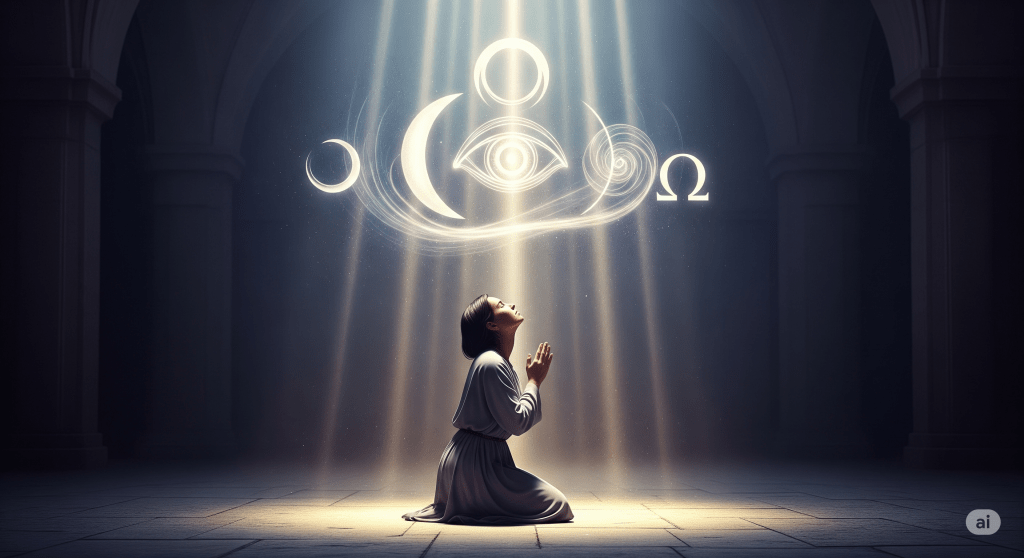
Una riflessione teologica sulla preghiera come manifestazione del nostro “logos personale” e via di divinizzazione
Ti sei mai chiesto se la tua preghiera quotidiana ti renda più simile a Dio? Non si tratta di una domanda retorica, ma di un interrogativo profondo che tocca il cuore stesso del mistero cristiano. Oggi voglio esplorare un parallelo affascinante tra il Logos divino – il Verbo di Dio – e la preghiera come esercizio della nostra “voce personale”, un dono che rappresenta un autentico “upgrade evolutivo” divino che ci rende partecipi della natura stessa di Dio.
Come il Logos era presso Dio dall’eternità e si è incarnato in Cristo, così il linguaggio umano – e in particolare la preghiera – è una manifestazione divina nell’uomo che, lungi dall’essere un semplice fenomeno biologico o culturale, ci divinizza nel senso più profondo del termine.
Il Logos Divino: La Parola che Crea e Redime
Per comprendere questo parallelo, devo prima addentrarmi nel mistero del Logos divino. Il Vangelo di Giovanni ci offre la chiave di lettura fondamentale: “In principio era il Verbo [Logos], e il Verbo era presso Dio, e il Verbo era Dio. Egli era, in principio, presso Dio. Tutto è stato fatto per mezzo di lui e senza di lui nulla è stato fatto di ciò che esiste” (Gv 1,1-3).
Il Logos non è semplicemente una “parola” nel senso comune del termine. È la Ragione divina, l’espressione perfetta e eterna dell’essenza di Dio, la Seconda Persona della Trinità attraverso cui tutto è stato creato. Come insegna il Catechismo della Chiesa Cattolica, “Il Verbo si è fatto carne per renderci ‘partecipi della natura divina’” (CCC 460, citando 2 Pt 1,4).
Sant’Atanasio di Alessandria, nel suo celebre trattato “Sull’Incarnazione del Verbo”, illumina questo mistero con una frase che ha attraversato i secoli: “Dio si è fatto uomo affinché l’uomo potesse diventare Dio”. Questa affermazione, che potrebbe suonare audace, esprime invece il cuore della fede cristiana: l’Incarnazione del Logos non è solo un evento storico, ma il fondamento stesso della nostra possibile divinizzazione.
San Tommaso d’Aquino, nella sua Summa Theologiae, approfondisce questa comprensione descrivendo il Verbo come l’espressione intellettuale perfetta di Dio (I, q. 34). È attraverso il Logos che Dio “parla” se stesso eternamente, e questa “parola” è così perfetta da essere Dio stesso.
Il Linguaggio Umano: Eco Terrena del Verbo Eterno
Ma qual è il legame tra questo mistero trinitario e la nostra esperienza quotidiana? La risposta risiede in una verità tanto semplice quanto profonda: il linguaggio umano è una manifestazione divina. Non si tratta di una mera capacità biologica evolutiva, ma di un autentico “upgrade” divino che ci distingue radicalmente dal resto della creazione.
Quando leggiamo nel libro della Genesi che l’uomo è creato “a immagine e somiglianza di Dio” (Gen 1,26-27), questa somiglianza si manifesta in modo particolare attraverso la nostra capacità di parlare, ragionare e – soprattutto – pregare. Il Salmo 33 ci ricorda che “con la parola del Signore furono fatti i cieli” (Sal 33,6): se Dio crea attraverso la parola, la nostra capacità di usare il linguaggio ci rende straordinariamente simili al Creatore.
Sant’Agostino, nelle sue Confessioni, riflette su questa realtà vedendo nel linguaggio umano un’eco del Verbo eterno. Non è un caso che il primo compito affidato ad Adamo nel paradiso terrestre fosse quello di “dare il nome” agli animali (Gen 2,19-20): attraverso la denominazione, l’uomo partecipa all’opera creatrice di Dio, ordinando e dando significato al mondo che lo circonda.
San Tommaso d’Aquino, nella Summa Contra Gentiles, sviluppa ulteriormente questo concetto, vedendo nel linguaggio umano una partecipazione alla razionalità divina stessa. La nostra capacità di formare concetti, di esprimerli attraverso parole e di comunicare verità è un riflesso imperfetto ma reale della perfezione del Logos divino.
La Preghiera: Il Nostro Logos Personale in Dialogo con Dio
Ed è qui che arrivo al cuore della mia riflessione: la preghiera come esercizio del nostro “logos personale”. Se il linguaggio ci rende simili a Dio, la preghiera rappresenta l’uso più elevato e divinizzante di questa capacità. Attraverso la preghiera, non stiamo semplicemente “parlando” – stiamo entrando in dialogo con l’Origine stessa di ogni parola.
San Paolo ci offre una comprensione profonda di questo mistero quando scrive: “Lo Spirito viene in aiuto alla nostra debolezza; non sappiamo infatti come pregare in modo conveniente, ma lo Spirito stesso intercede con gemiti inesprimibili” (Rm 8,26). La preghiera, quindi, non è solo un’attività umana, ma un’azione in cui lo Spirito Santo stesso ci coinvolge, elevando le nostre parole oltre i loro limiti naturali.
Il Catechismo della Chiesa Cattolica definisce la preghiera come “elevazione dell’anima a Dio o domanda a Dio di beni convenienti” (CCC 2590). Ma è importante comprendere che questa “elevazione” non è solo spirituale nel senso generico del termine: è un autentico processo di divinizzazione. Come insegna la dottrina cattolica sulla grazia santificante, attraverso la preghiera diventiamo realmente partecipi della vita divina (CCC 1996-2005).
Tertulliano, uno dei primi grandi teologi cristiani, nel suo trattato “De Oratione”, descrive la preghiera come “testimonianza a Dio e ricompensa della fede”. Ogni volta che preghiamo, non stiamo solo comunicando con Dio, ma stiamo testimoniando la nostra partecipazione alla Sua natura divina.
San Tommaso d’Aquino, nella Summa Theologiae, offre una prospettiva ancora più profonda: la preghiera è un atto della ragione illuminata dalla fede che ci unisce a Dio (II-II, q. 83). È importante notare che, secondo l’Aquinate, la preghiera non cambia Dio – che è immutabile – ma cambia noi, disponendoci a ricevere i Suoi doni e conformandoci sempre più alla Sua volontà.
I Testimoni della Divinizzazione: Santi e Padri della Chiesa
La teoria trova la sua conferma più convincente nella vita concreta dei santi, che rappresentano i “laboratori viventi” di questa divinizzazione attraverso la preghiera. Le loro testimonianze non sono mere speculazioni teologiche, ma esperienze vissute che illuminano il nostro cammino.
Santa Teresa d’Avila, nel suo capolavoro “Il Castello Interiore”, descrive con precisione scientifica quasi moderna il processo attraverso cui la preghiera trasforma l’anima umana. La sua celebre affermazione che “la preghiera è necessaria come l’aria, come il sangue nei nostri corpi” non è un’iperbole poetica, ma l’espressione di una verità sperimentata: senza preghiera, la vita spirituale si atrofizza così come il corpo senza ossigeno.
Teresa descrive sette “dimore” o stadi di crescita spirituale, ciascuno caratterizzato da una forma sempre più elevata di preghiera. In questa progressione, vediamo chiaramente come l’esercizio del nostro “logos personale” attraverso la preghiera ci conduca verso una sempre maggiore unione con Dio, fino al matrimonio spirituale, in cui l’anima diventa, per grazia, “una cosa sola” con Dio.
San Giovanni della Croce, compagno di riforma di Santa Teresa, nella “Salita del Monte Carmelo” e nella “Notte Oscura dell’Anima”, descrive il processo parallelo attraverso cui la preghiera purifica e divinizza l’anima. Il suo insegnamento sulla “notte oscura” non è pessimistico, ma profondamente ottimistico: è attraverso la purificazione della preghiera che l’anima viene preparata per l’unione divina.
Tra i Padri della Chiesa, San Giovanni Crisostomo – il “Bocca d’Oro” per la sua eloquenza – offre una sintesi luminosa quando afferma che “la preghiera è la luce dell’anima”. Questa metafora è particolarmente significativa: come la luce fisica ci permette di vedere il mondo materiale, così la preghiera illumina la nostra intelligenza spirituale, permettendoci di “vedere” Dio e di riconoscere la nostra chiamata alla divinizzazione.
San Francesco d’Assisi rappresenta forse l’esempio più concreto di come la preghiera incessante possa trasformare un essere umano in un’autentica “espressione” del Logos divino. Le biografie francescane ci raccontano che il Poverello di Assisi si rivolgeva a Dio nelle preghiere fino a cinquanta volte al giorno, vedendo in ogni creatura – dal sole alla morte – un’opportunità di dialogo con l’Altissimo. Non è un caso che Francesco abbia ricevuto le stigmate: il suo corpo stesso era diventato un “logos vivente”, un’immagine parlante del Cristo crocifisso.
Il Mistero dell’Analogia: Limiti e Possibilità
È importante, tuttavia, mantenere la giusta prospettiva teologica su questa analogia. Come ci ricorda costantemente il Magistero della Chiesa, la nostra divinizzazione attraverso la preghiera avviene sempre per grazia, non per merito umano (CCC 1996). Non diventiamo “dèi” nel senso panteistico del termine, ma diventiamo partecipi della natura divina rimanendo sempre e pienamente creature.
L’analogia tra il Logos divino e il nostro “logos personale” è reale ma imperfetta. Come insegna il Concilio Lateranense IV, in ogni analogia tra Creatore e creatura, la dissomiglianza è sempre maggiore della somiglianza. Il nostro linguaggio, per quanto elevato dalla grazia, rimane sempre un riflesso finito dell’infinita perfezione del Verbo divino.
Tuttavia, questa limitazione non sminuisce la bellezza e la profondità del mistero. Al contrario, ci ricorda che la preghiera è sempre un dono che viene dall’alto, una grazia che ci viene concessa, non una conquista che possiamo ottenere con le nostre sole forze umane.
Implicazioni per la Vita Quotidiana: La Preghiera come Trasformazione
Qual è, dunque, l’implicazione pratica di questa riflessione teologica per la nostra vita quotidiana? La risposta è tanto semplice quanto rivoluzionaria: ogni preghiera, anche la più umile, ci sta divinizzando.
Quando recitiamo il Padre Nostro, non stiamo semplicemente ripetendo parole apprese a memoria. Stiamo esercitando il nostro “logos personale” in dialogo con il Logos divino, permettendo che la grazia di Dio ci trasformi dall’interno. Ogni “Ave Maria” è un’eco della salutazione dell’arcangelo Gabriele che continuamente si realizza nell’anima che prega. Ogni momento di adorazione silenziosa è una partecipazione al silenzio contemplativo del Verbo eterno nel seno del Padre.
La liturgia eucaristica esprime questa verità in modo particolarmente eloquente nella preghiera sul calice: “Per il mistero di quest’acqua e vino, possiamo condividere la divinità di Cristo che si è degnato di farsi partecipe della nostra umanità”. Come l’acqua si unisce al vino perdendo la sua identità per assumerne una superiore, così la nostra preghiera ci unisce a Dio trasformandoci in qualcosa di più grande di ciò che siamo per natura.
Non devo pensare che questo processo richieda necessariamente estasi mistiche o fenomeni straordinari. Come insegna San Francesco di Sales nella “Filotea”, la santità – e quindi la divinizzazione – è possibile in ogni stato di vita. Il commerciante che inizia la giornata lavorativa con un’Ave Maria, la madre che sussurra una giaculatoria mentre accudisce i figli, lo studente che offre a Dio le proprie fatiche: tutti stanno esercitando il proprio logos personale in dialogo con il Logos divino, tutti stanno percorrendo la via della divinizzazione.
Conclusione: L’Invito al Dialogo Eterno
In conclusione, il parallelo tra Logos e preghiera non è solo un esercizio di speculazione teologica, ma una verità che può trasformare radicalmente la mia comprensione della vita cristiana. Ogni volta che prego, sto partecipando al mistero stesso dell’Incarnazione: come il Verbo si è fatto carne, così la mia carne – attraverso la preghiera – viene elevata alla dimensione divina.
Questo significa che la preghiera non è mai un’attività “privata” nel senso individualistico del termine. Quando prego, entro in comunione con l’intera economia trinitaria: il Padre che mi ascolta, il Figlio che intercede per me, lo Spirito Santo che prega in me con gemiti inesprimibili. La mia voce si unisce al coro eterno degli angeli e dei santi, il mio logos personale risuona in armonia con il Logos divino.
San Pietro ci ricorda che siamo chiamati a diventare “partecipi della natura divina” (2 Pt 1,4). Questa partecipazione non è un’astrazione teologica, ma una realtà concreta che si attualizza ogni volta che apro il cuore alla preghiera. In questo senso, posso dire che la preghiera è davvero il nostro “upgrade evolutivo” divino, il dono che ci distingue da ogni altra creatura e ci apre all’infinito.
L’invito che scaturisce da questa riflessione è tanto semplice quanto esigente: prova a pregare oggi con questa consapevolezza. Prova a vedere nella tua preghiera quotidiana non solo un dovere religioso o una pratica consolatoria, ma l’esercizio del tuo logos personale in dialogo eterno con il Logos divino. Potresti scoprire che quello che chiamiamo “Paradiso” non è un luogo lontano nel tempo e nello spazio, ma una dimensione che inizia qui e ora, ogni volta che il nostro cuore si apre alla preghiera autentica.
Come diceva San Paolo: “Pregate incessantemente” (1 Ts 5,17). Non perché Dio abbia bisogno delle nostre preghiere, ma perché noi abbiamo bisogno di diventare preghiera vivente, logos personale in dialogo costante con il Logos eterno che è Cristo Gesù, nostro Signore.
In questo dialogo incessante si compie il mistero della nostra divinizzazione, e la nostra vita diventa ciò che è chiamata ad essere: un riflesso imperfetto ma reale della perfezione divina, una parola pronunciata dall’amore eterno di Dio nel linguaggio del tempo e della storia.
ENGLISH
The Parallel Between the Logos and Prayer: A Divine Dialogue That Transforms Man
A theological reflection on prayer as a manifestation of our “personal logos” and a path to divinization.
Have you ever wondered if your daily prayer makes you more like God? This is not a rhetorical question, but a profound one that touches the very heart of the Christian mystery. Today I want to explore a fascinating parallel between the divine Logos – the Word of God – and prayer as an exercise of our “personal voice,” a gift that represents an authentic divine “evolutionary upgrade” that makes us partakers of God’s very nature.
Just as the Logos was with God from eternity and became incarnate in Christ, so too is human language—and prayer in particular—a divine manifestation within humanity that, far from being a simple biological or cultural phenomenon, divinizes us in the deepest sense of the term.
The Divine Logos: The Word that Creates and Redeems
To understand this parallel, I must first delve into the mystery of the divine Logos. The Gospel of John offers us the fundamental key: “In the beginning was the Word [Logos], and the Word was with God, and the Word was God. He was in the beginning with God. All things were made through him, and without him nothing was made that has been made” (John 1:1-3).
The Logos is not simply a “word” in the common sense of the term. It is the divine Reason, the perfect and eternal expression of God’s essence, the Second Person of the Trinity through whom everything was created. As the Catechism of the Catholic Church teaches, “The Word became flesh to make us ‘partakers of the divine nature’” (CCC 460, citing 2 Pet 1:4).
Saint Athanasius of Alexandria, in his famous treatise “On the Incarnation of the Word,” illuminates this mystery with a phrase that has spanned the centuries: “God became man that man might become God.” This statement, which might sound audacious, instead expresses the heart of the Christian faith: the Incarnation of the Logos is not just a historical event, but the very foundation of our potential divinization.
Saint Thomas Aquinas, in his Summa Theologiae, deepens this understanding by describing the Word as the perfect intellectual expression of God (I, q. 34). It is through the Logos that God “speaks” Himself eternally, and this “word” is so perfect that it is God Himself.
Human Language: An Earthly Echo of the Eternal Word
But what is the connection between this Trinitarian mystery and our daily experience? The answer lies in a truth as simple as it is profound: human language is a divine manifestation. It is not a mere evolutionary biological capacity, but an authentic divine “upgrade” that radically distinguishes us from the rest of creation.
When we read in the book of Genesis that man is created “in the image and likeness of God” (Gen 1:26-27), this resemblance is manifested in a particular way through our ability to speak, reason, and—especially—pray. Psalm 33 reminds us that “by the word of the Lord the heavens were made” (Ps 33:6): if God creates through the word, our ability to use language makes us extraordinarily similar to the Creator.
Saint Augustine, in his Confessions, reflects on this reality by seeing human language as an echo of the eternal Word. It is no coincidence that the first task entrusted to Adam in the Garden of Eden was to “name” the animals (Gen 2:19-20): through naming, man participates in God’s creative work, ordering and giving meaning to the world around him.
Saint Thomas Aquinas, in the Summa Contra Gentiles, further develops this concept, seeing human language as a participation in divine rationality itself. Our ability to form concepts, express them through words, and communicate truths is an imperfect but real reflection of the perfection of the divine Logos.
Prayer: Our Personal Logos in Dialogue with God
And this is where I get to the heart of my reflection: prayer as the exercise of our “personal logos.” If language makes us similar to God, prayer represents the highest and most divinizing use of this capacity. Through prayer, we are not simply “speaking”—we are entering into dialogue with the very Source of all words.
Saint Paul offers a profound understanding of this mystery when he writes: “The Spirit helps us in our weakness. For we do not know what to pray for as we ought, but the Spirit himself intercedes for us with groanings too deep for words” (Rom 8:26). Prayer, therefore, is not just a human activity, but an action in which the Holy Spirit Himself involves us, elevating our words beyond their natural limits.
The Catechism of the Catholic Church defines prayer as “the raising of one’s mind and heart to God or the requesting of good things from God” (CCC 2590). But it is important to understand that this “raising” is not just spiritual in the generic sense of the term: it is an authentic process of divinization. As Catholic doctrine on sanctifying grace teaches, through prayer we truly become partakers of the divine life (CCC 1996-2005).
Tertullian, one of the first great Christian theologians, in his treatise “On Prayer,” describes prayer as “a testimony to God and a reward of faith.” Every time we pray, we are not only communicating with God, but we are also witnessing our participation in His divine nature.
Saint Thomas Aquinas, in the Summa Theologiae, offers an even deeper perspective: prayer is an act of reason, illuminated by faith, that unites us to God (II-II, q. 83). It is important to note that, according to Aquinas, prayer does not change God—who is immutable—but changes us, disposing us to receive His gifts and conforming us more and more to His will.
The Witnesses of Divinization: Saints and Church Fathers
The theory finds its most convincing confirmation in the concrete lives of the saints, who represent the “living laboratories” of this divinization through prayer. Their testimonies are not mere theological speculations, but lived experiences that illuminate our path.
Saint Teresa of Avila, in her masterpiece The Interior Castle, describes with almost modern scientific precision the process by which prayer transforms the human soul. Her famous statement that “prayer is as necessary as the air, as the blood in our bodies” is not a poetic hyperbole, but the expression of a truth she experienced: without prayer, spiritual life atrophies just as the body does without oxygen.
Teresa describes seven “mansions” or stages of spiritual growth, each characterized by an ever-higher form of prayer. In this progression, we clearly see how the exercise of our “personal logos” through prayer leads us toward an ever-greater union with God, up to the spiritual marriage, in which the soul becomes, by grace, “one thing” with God.
Saint John of the Cross, a companion in reform of Saint Teresa, in his Ascent of Mount Carmel and The Dark Night of the Soul, describes the parallel process through which prayer purifies and divinizes the soul. His teaching on the “dark night” is not pessimistic, but deeply optimistic: it is through the purification of prayer that the soul is prepared for divine union.
Among the Church Fathers, Saint John Chrysostom—the “Golden-mouthed” for his eloquence—offers a luminous synthesis when he states that “prayer is the light of the soul.” This metaphor is particularly significant: just as physical light allows us to see the material world, so too does prayer illuminate our spiritual intelligence, allowing us to “see” God and recognize our call to divinization.
Saint Francis of Assisi perhaps represents the most concrete example of how ceaseless prayer can transform a human being into an authentic “expression” of the divine Logos. The Franciscan biographies tell us that the “Poor Man of Assisi” addressed God in prayer up to fifty times a day, seeing in every creature—from the sun to death—an opportunity for dialogue with the Most High. It is no coincidence that Francis received the stigmata: his very body had become a “living logos,” a speaking image of the crucified Christ.
The Mystery of Analogy: Limits and Possibilities
It is important, however, to maintain the right theological perspective on this analogy. As the Magisterium of the Church constantly reminds us, our divinization through prayer always occurs by grace, not through human merit (CCC 1996). We do not become “gods” in the pantheistic sense of the term, but we become partakers of the divine nature while remaining always and fully creatures.
The analogy between the divine Logos and our “personal logos” is real but imperfect. As the Fourth Lateran Council teaches, in every analogy between Creator and creature, the dissimilarity is always greater than the similarity. Our language, however elevated by grace, always remains a finite reflection of the infinite perfection of the divine Word.
However, this limitation does not diminish the beauty and depth of the mystery. On the contrary, it reminds us that prayer is always a gift that comes from above, a grace that is granted to us, not a conquest that we can achieve by our own human strength alone.
Implications for Daily Life: Prayer as Transformation
What, then, is the practical implication of this theological reflection for our daily lives? The answer is as simple as it is revolutionary: every prayer, even the most humble, is divinizing us.
When we recite the Our Father, we are not simply repeating words learned by heart. We are exercising our “personal logos” in dialogue with the divine Logos, allowing the grace of God to transform us from within. Every “Hail Mary” is an echo of the salutation of the archangel Gabriel that is continuously fulfilled in the praying soul. Every moment of silent adoration is a participation in the contemplative silence of the eternal Word in the bosom of the Father.
The Eucharistic liturgy expresses this truth in a particularly eloquent way in the prayer over the chalice: “By the mystery of this water and wine, may we come to share in the divinity of Christ who humbled himself to share in our humanity.” Just as the water unites with the wine, losing its identity to assume a higher one, so our prayer unites us with God, transforming us into something greater than what we are by nature.
I do not need to think that this process necessarily requires mystical ecstasies or extraordinary phenomena. As Saint Francis de Sales teaches in the Philothea, holiness—and thus divinization—is possible in every state of life. The merchant who begins his workday with a Hail Mary, the mother who whispers a short prayer while caring for her children, the student who offers his labors to God: all are exercising their personal logos in dialogue with the divine Logos, all are walking the path of divinization.
Conclusion: The Invitation to Eternal Dialogue
In conclusion, the parallel between the Logos and prayer is not just an exercise in theological speculation, but a truth that can radically transform my understanding of the Christian life. Every time I pray, I am participating in the very mystery of the Incarnation: just as the Word became flesh, so my flesh—through prayer—is elevated to the divine dimension.
This means that prayer is never a “private” activity in the individualistic sense of the term. When I pray, I enter into communion with the entire Trinitarian economy: the Father who listens to me, the Son who intercedes for me, the Holy Spirit who prays within me with groanings too deep for words. My voice joins the eternal chorus of angels and saints, my personal logos resonates in harmony with the divine Logos.
Saint Peter reminds us that we are called to become “partakers of the divine nature” (2 Pet 1:4). This participation is not a theological abstraction, but a concrete reality that is actualized every time I open my heart to prayer. In this sense, I can say that prayer is truly our divine “evolutionary upgrade,” the gift that distinguishes us from every other creature and opens us to the infinite.
The invitation that springs from this reflection is as simple as it is demanding: try to pray today with this awareness. Try to see your daily prayer not just as a religious duty or a comforting practice, but as the exercise of your personal logos in eternal dialogue with the divine Logos. You might discover that what we call “Heaven” is not a distant place in time and space, but a dimension that begins here and now, every time our heart opens to authentic prayer.
As Saint Paul said: “Pray without ceasing” (1 Thess 5:17). Not because God needs our prayers, but because we need to become a living prayer, a personal logos in constant dialogue with the eternal Logos who is Christ Jesus, our Lord.
In this incessant dialogue, the mystery of our divinization is fulfilled, and our life becomes what it is called to be: an imperfect but real reflection of divine perfection, a word spoken by God’s eternal love in the language of time and history.
 Alberto Giordano Verso
Lascia un commento