Riassunto puntate precedenti:
Una chiacchierata su questo articolo
La Croce e l’Unione Mistica: Il Paradosso della Fede Adulta
La fede come lavoro continuo
Quello di cui voglio parlare oggi è la fede. Ne ho già parlato in diverse occasioni e ne parlerò ancora, perché è un tema talmente grande e vasto che è impensabile poterlo ridurre a parole. Eppure bisogna che ne parliamo.
La fede cristiano-cattolica che porto, che cerco di esplorare e di portare in vita indegnamente, è un lavoro continuo. C’è spazio e tempo per una fede più infantile, una fede bambina, e c’è il tentativo che sto provando a portare avanti di una fede più adulta. A 53 anni, cerco una fede che sia una questione seria.
La fede è un vestito che portiamo addosso, che cerchiamo di adattare alla nostra persona. Allo stesso tempo è una visione che cerchiamo di raffinare, di pulire, di rendere più limpida per vedere cos’è la vita, qual è il suo senso, a cosa possiamo aspirare partendo dalla nostra umile situazione.
La distruzione dell’ego nella fede cristiana
La fede cristiano-cattolica prescinde per sua natura dall’esaltazione dell’ego – anzi, ne è la distruzione. Non è l’unica che porta alla disintegrazione dell’ego, ma almeno così come la vedo io in questo momento, nella mia esperienza è quella che più di tutte porta avanti questo concetto.
È composta da diversi capisaldi fondamentali con i quali è necessario confrontarsi: alcuni misteri, alcuni dogmi, alcune realtà incrollabili che in apparenza possono sembrare semplici, ma che nella realtà sono enormi pillole da digerire. Si spezzettano, ci si confronta con esse per cercare di estrarre da questo lavorio interiore qualcosa che ci porti una visione maggiore, allargata della fede e del senso.
Il mistero della croce
Una di queste realtà fondamentali è la croce – robetta da nulla, eh? La croce è il luogo dove Gesù finisce la sua vita. Si può dire che tutta la prima metà della storia di Gesù prepari la croce.
Come ci arriva alla croce? Ci arriva da perdente. Gesù non è un supereroe, un condottiero che viene sconfitto e poi ucciso. Gesù è la mitezza e l’umiltà. Poche ore prima di venire inchiodato sulla croce, lava i piedi ai suoi discepoli. In tutto il suo cammino ci mostra la mitezza e l’umiltà.
Si arrende, si lascia succedere la sua incarcerazione, la sua flagellazione, la sua tortura che lo porterà alla morte. Dagli evangeli si evidenzia chiaramente che lui aveva già conoscenza di tutto questo, di questo calice amaro che avrebbe dovuto bere.
L’incarnazione e la kenosis
Se vogliamo fare una valutazione di cos’è la croce, dobbiamo immaginare che sia qualcosa a cui lui è andato incontro sapendo di andarci. Lui è l’incarnazione di Dio. Dio si svuota attraverso la kenosis e viene tra noi a mostrarci la strada.
Il suo arrivare sulla croce per noi è la dimostrazione di che cos’è il mondo, di che cosa fa il mondo al messaggio divino che era già presente prima ancora che Gesù venisse ad incarnarsi fra di noi. È stata la sua tangibile testimonianza, il mostrare a noi in modo palese cosa il mondo fa al suo messaggio.
Il promemoria dell’aridità del mondo
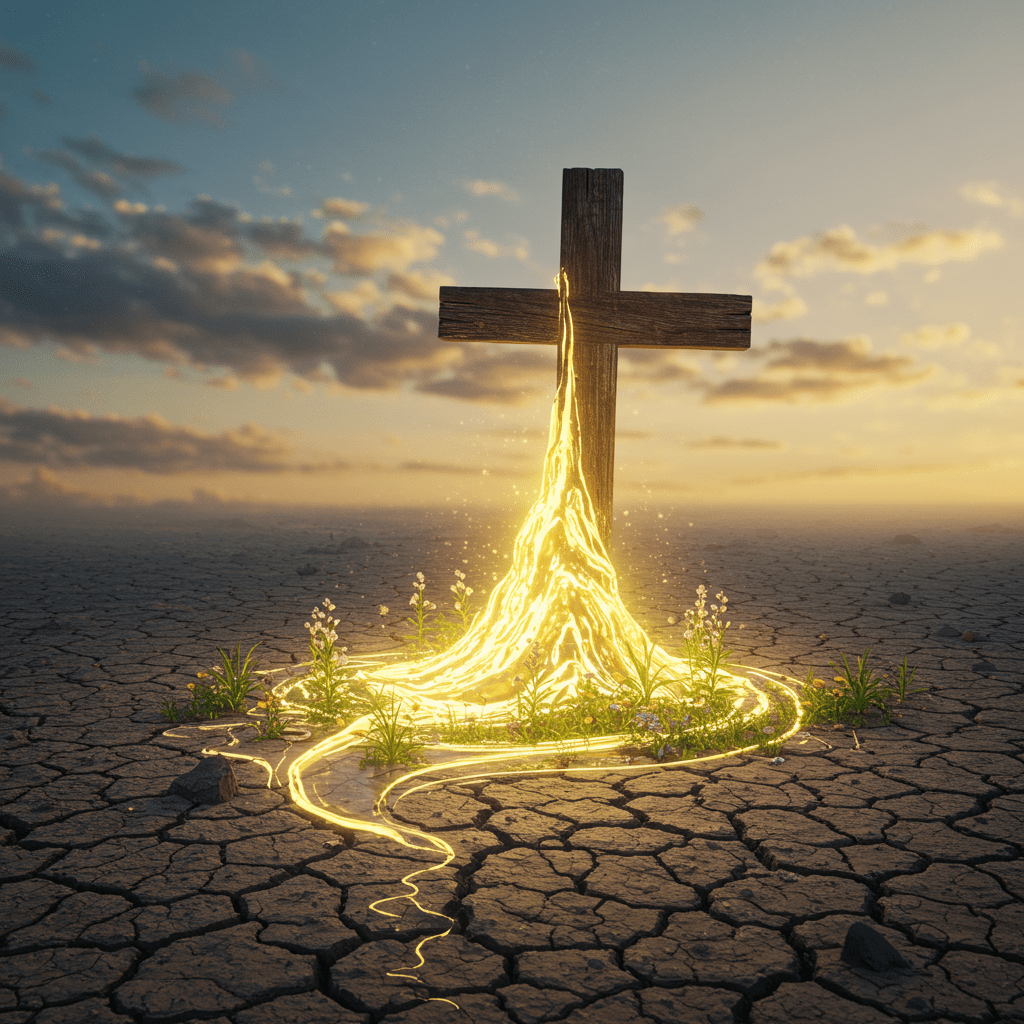
Quando guardo la croce, mi rendo conto che non penso più soltanto alla morte di Cristo, ma penso all’aridità di come questo mondo, se lasciato a se stesso, si relazioni al messaggio divino. Il risultato è lì: un promemoria orribile di quanto questo mondo sia ottuso, sordo al messaggio di Cristo, quanto sia intrinsecamente malvagio.
Il messaggio pre-cristiano dell’alleanza ebraica ci racconta che il mondo nel quale ci troviamo è quello conseguente alla natura del peccato originale. La creazione, dopo il peccato originale, è diventata aperta al male. Non stupisce quindi che sia una specie di inferno in terra in cui prevalgono leggi, guerre, sopraffazioni.
Il lento miglioramento e le ferite aperte
Anche se nella storia dell’umanità possiamo vedere un lento ma costante miglioramento delle condizioni degli esseri umani e del rispetto fra gli individui, non possiamo non vedere – mentre registro questo nel 2025 – le ferite aperte dall’egoismo e dalla volontà di potere che ancora oggi lacerano il tessuto della società in cui viviamo.
La croce è un promemoria, un passaggio fondamentale che, suo malgrado, non avendo egli commesso nessun peccato, gli è toccato vivere. Dio stesso, sofferente, sanguinante, morto – questo è il risultato quando qualcosa nella nostra società vuole cancellare il divino: lo uccide.
Il paradosso della redenzione
Come è possibile che la presenza dell’unico essere divino sulla croce allo stesso tempo redima tutto il popolo? Come può essere che il più efferato dei peccati, dove il più innocente degli agnelli viene massacrato, sia per noi una possibilità di salvezza? Noi che l’abbiamo “ucciso”, noi che se abbandonati a noi stessi ascoltiamo così spesso la nostra pancia, i nostri istinti, la nostra volontà di potere e prevaricazione sugli altri.
Come può quel momento avere un effetto sui miei peccati?
La santificazione attraverso il sacrificio
Proprio perché noi abbiamo peccato verso l’unica cosa che non aveva peccato. E questa cosa lo sapeva che sarebbe finita così. Ci ha mostrato umilmente che avrebbe accettato, che ha accettato questa nostra risposta. Ci ha mostrato che sono del tutto inutili, inefficaci i nostri peccati nei confronti del regno dove il regnante è lui.
Attraverso la sua morte e resurrezione, attraverso il passaggio della croce – se non ci fosse stata la morte non ci sarebbe potuta essere la resurrezione, ma se non ci fosse stata la resurrezione non ci sarebbe il cristianesimo che conosciamo oggi – attraverso l’inutilità, la vacuità del peccato, la croce ci mostra che è possibile una redenzione.
La materia santificata
Gesù incarnandosi ha santificato la materia, santificato questo mondo. A partire dalla carne che lo ha accolto come tabernacolo iniziale, che era già predisposta ma è diventata sacra attraverso quel passaggio. Versando il suo sangue sulla croce, ha intriso la materialità di questo mondo della sua presenza, cosa che prima non era evidentemente. Ci ha mostrato che la carne, la materia di questo mondo possano essere rinnovate.
La croce, Gesù sulla croce, è la foto del peccato, la foto della sconfitta del messaggio divino nella realtà così come l’abbiamo sempre portata avanti. Ma è anche l’ultima foto di un mondo dominato dal peccato, un attimo prima di essere santificato, reso sacro.
La chance della rinascita
Lui ci dà, attraverso la sua morte, la chance della rinascita attraverso questa santificazione del peccato. Riesco a vedere in questa assurda e paradossale affermazione un senso se penso al fatto che il peccato più grave – il peccato contro Dio, il rivoltarsi della creatura verso il creatore – non vuol dire nulla, non vince.
Abbiamo preso la cosa più sacra e l’abbiamo dissacrata, e questa cosa è del tutto inutile in quest’ottica. Non c’è peccato che rimanga in piedi davanti alla luce di quello che ha narrato la storia di Cristo nell’umanità.
Il cammino verso la santità
Questo è il modo attraverso il quale si cerca, da adulti, di portare luce, di portare senso, di portare presenza individuale nella narrazione santa, nella narrazione divina. So, e sono convinto di essere in buona compagnia, di essere un grave peccatore. La mia via verso la santità è un assurdo – come la via della formica alla conquista di Marte. La santità non è nelle mie possibilità.
L’unico che ha la possibilità di santificare qualcosa di così marcio come il peccato è ovviamente Dio. Ma la sua testimonianza del fatto che sia venuto qui a casa nostra a trasformare la realtà del peccato ci insegna che persino noi ce la possiamo fare, se lo seguiamo.
La fede che trasforma
Le sue parole sono chiare. Il richiamo continuo alla fede e questa discussione sulla fede sono una modalità attraverso la quale cerco di portare le sue parole nella mia vita, cercando di comprenderle in modo profondo, non soltanto razionale. Della razionalità non ce ne facciamo proprio nulla nel campo della fede.
Vogliamo portare questa conoscenza, questa visione, queste credenze dentro di noi con una fiducia nuova che deriva dal contatto, dalla carezza col divino, per trasformare la nostra carne – intendo le nostre profondità che stanno molto al di sotto della nostra razionalità, al di sotto della nostra coscienza – per far sì che con più facilità possano emergere nella nostra vita segnali di conferma, di messa in pratica, di realizzazione di quello che è possibile secondo le parole del Cristo attraverso la fede.
La fede che salva
È la fede che salva le persone, la fede in lui che salva le persone. Certo, è la grazia che arriva da Dio a fare il miracolo – lui solo è il santo, lui solo è il Signore. Non ci sono veramente dei santi al di là di lui. Ci sono persone che hanno permesso a lui di crescere dentro di loro ed emergere.
Qualità nuove che non siano legate al loro ego, alla loro storia, alla loro piccolezza, ma che siano storie che testimoniano l’apertura verso l’immanente, verso il divino. Che consentano quindi di emergere dentro ogni singolo individuo, attraverso le parole del Cristo, attraverso la fede, l’emergere di segnali nuovi, miracolosi.
Il miracolo della vita che fiorisce
La vita è già un miracolo per come esiste, per come è intrinsecamente esistente. Non c’è probabilmente bisogno che veramente spostiamo le montagne. Non possiamo non permettere a questo miracolo che è la nostra vita – che non ci appartiene – di fiorire, irradiando nel mondo quello che da progetto iniziale vi è contenuto.
Il lavoro di far crescere la fede all’interno di se stessi non è altro che un lavoro di eliminazione di quello che occlude lo splendore che può sorgere da dentro di noi, attraverso di noi – non certo per merito nostro.
ENGLISH
The Cross and the Mystical Union: The Paradox of Adult Faith
Faith as a Continuous Work
What I want to talk about today is faith. I’ve spoken about it on several occasions and will continue to do so, because it’s such a vast and immense topic that it’s impossible to reduce it to words. And yet, we must talk about it.
The Christian-Catholic faith that I carry, that I try to explore and bring to life unworthily, is a continuous work. There is time and space for a more childish faith, a childlike faith, and there is the attempt I am trying to pursue of a more adult faith. At 53, I am seeking a faith that is a serious matter.
Faith is a garment we wear, which we try to adapt to our person. At the same time, it is a vision that we try to refine, to clean, to make clearer to see what life is, what its meaning is, and what we can aspire to, starting from our humble situation.
The Destruction of the Ego in Christian Faith
Christian-Catholic faith, by its nature, disregards the exaltation of the ego—in fact, it is the destruction of it. It’s not the only one that leads to the disintegration of the ego, but at least as I see it now, in my experience, it is the one that most of all advances this concept.
It is made up of several fundamental cornerstones that must be confronted: some mysteries, some dogmas, some unshakable realities that may seem simple on the surface, but are in reality huge pills to swallow. We break them down, we confront them to try to extract something from this inner work that gives us a greater, broader vision of faith and meaning.
The Mystery of the Cross
One of these fundamental realities is the cross—a small thing, right? The cross is the place where Jesus ends his life. One could say that the entire first half of Jesus’s story prepares for the cross.
How does he get to the cross? He gets there as a loser. Jesus is not a superhero, a leader who is defeated and then killed. Jesus is meekness and humility. A few hours before being nailed to the cross, he washes his disciples’ feet. Throughout his journey, he shows us meekness and humility.
He surrenders, he lets his incarceration, his flagellation, his torture that will lead to his death, happen. The Gospels clearly show that he already had knowledge of all this, of this bitter cup he would have to drink.
Incarnation and Kenosis
If we want to evaluate what the cross is, we must imagine that it is something he went to meet knowing he was going there. He is the incarnation of God. God empties himself through kenosis and comes among us to show us the way.
His arrival on the cross for us is the demonstration of what the world is, of what the world does to the divine message that was already present even before Jesus came to be incarnated among us. It was his tangible testimony, showing us clearly what the world does to his message.
The Reminder of the World’s Barrenness
When I look at the cross, I realize that I no longer think only of Christ’s death, but I think of the barrenness of how this world, if left to itself, relates to the divine message. The result is there: a horrible reminder of how obtuse and deaf this world is to Christ’s message, how intrinsically evil it is.
The pre-Christian message of the Jewish covenant tells us that the world we find ourselves in is the one resulting from the nature of original sin. Creation, after original sin, became open to evil. It is not surprising, then, that it is a kind of hell on earth where laws, wars, and oppression prevail.
Slow Improvement and Open Wounds
Even though in the history of humanity we can see a slow but constant improvement in the conditions of human beings and respect between individuals, we cannot fail to see—as I record this in 2025—the open wounds of selfishness and the will to power that still today tear at the fabric of the society we live in.
The cross is a reminder, a fundamental passage that, through no fault of his own, as he committed no sin, he was forced to endure. God himself, suffering, bleeding, dead—this is the result when something in our society wants to cancel out the divine: it kills it.
The Paradox of Redemption
How is it possible that the presence of the one divine being on the cross at the same time redeems all people? How can it be that the most heinous of sins, where the most innocent of lambs is slaughtered, is a possibility of salvation for us? We who “killed” him, we who, when left to ourselves, so often listen to our gut, our instincts, our will to power and prevarication over others.
How can that moment have an effect on my sins?
Sanctification Through Sacrifice
Precisely because we have sinned against the only thing that had not sinned. And this thing knew it would end this way. He showed us humbly that he would accept, that he accepted this response of ours. He showed us that our sins are completely useless, ineffective against the kingdom where he is the ruler.
Through his death and resurrection, through the passage of the cross—if there had not been death, there could not have been resurrection, but if there had not been resurrection, there would not be the Christianity we know today—through the uselessness, the emptiness of sin, the cross shows us that redemption is possible.
Sanctified Matter
By incarnating himself, Jesus sanctified matter, sanctified this world. Starting with the flesh that received him as an initial tabernacle, which was already predisposed but became sacred through that passage. By shedding his blood on the cross, he imbued the materiality of this world with his presence, something that was evidently not there before. He showed us that the flesh, the matter of this world, can be renewed.
The cross, Jesus on the cross, is the photo of sin, the photo of the divine message’s defeat in the reality we have always carried forward. But it is also the last photo of a world dominated by sin, a moment before being sanctified, made sacred.
The Chance of Rebirth
He gives us, through his death, the chance of rebirth through this sanctification of sin. I can see a meaning in this absurd and paradoxical statement if I think about the fact that the gravest sin—the sin against God, the revolt of the creature against the creator—means nothing, it does not win.
We took the most sacred thing and desecrated it, and this act is completely useless in this perspective. No sin stands up before the light of what the story of Christ has narrated in humanity.
The Path to Holiness
This is the way through which one tries, as an adult, to bring light, to bring meaning, to bring an individual presence into the holy narrative, into the divine narrative. I know, and I am convinced I am in good company, that I am a great sinner. My path to holiness is an absurdity—like an ant’s path to conquering Mars. Holiness is not within my possibilities.
The only one who has the possibility to sanctify something as rotten as sin is obviously God. But his testimony of the fact that he came here to our home to transform the reality of sin teaches us that even we can do it, if we follow him.
Faith That Transforms
His words are clear. The continuous call to faith and this discussion on faith are a way through which I try to bring his words into my life, seeking to understand them in a profound way, not just a rational one. We can do absolutely nothing with rationality in the field of faith.
We want to bring this knowledge, this vision, these beliefs inside us with a new trust that comes from contact, from the caress with the divine, to transform our flesh—I mean our depths that are far below our rationality, below our consciousness—to make it easier for signals of confirmation, of putting into practice, of realization of what is possible according to Christ’s words through faith, to emerge in our lives.
Faith That Saves
It is faith that saves people, faith in him that saves people. Of course, it is grace that comes from God to work the miracle—he alone is the holy one, he alone is the Lord. There are truly no saints beyond him. There are people who have allowed him to grow inside them and emerge.
New qualities that are not tied to their ego, to their history, to their smallness, but which are stories that testify to an openness to the imminent, to the divine. Which therefore allow new, miraculous signals to emerge within each individual, through Christ’s words, through faith.
The Miracle of Life Flourishing
Life is already a miracle in how it exists, in how it is intrinsically existent. There is probably no need for us to truly move mountains. We cannot not allow this miracle that is our life—which does not belong to us—to flourish, radiating into the world what is contained in it from the initial design.
The work of making faith grow within oneself is nothing more than a work of eliminating what obstructs the splendor that can arise from within us, through us—certainly not by our own merit.
 Alberto Giordano Verso
Lascia un commento