Riassunto puntate precedenti:
Chiacchierata su questo articolo:
Perdere sé stessi
Nel precedente articolo ho sottolineato nuovamente quanto sia importante “sentire” la sete come condizione necessaria per l’avvio di un cammino spirituale proficuo.
Esiste però un’altra condizione fondamentale che va messa a fuoco, anche se non necessariamente raggiunta completamente fin dall’inizio: l’abbandono dell’Ego.
La natura dell’Ego
L’Ego è il frutto di una visione distorta di ciò che noi siamo in realtà, una narrazione illusoria che però non va semplicemente “corretta”. L’Ego rappresenta un artefatto culturale nato dallo sviluppo dell’autocoscienza nell’essere umano.
L’uomo ha iniziato a “percepirsi” come individuo separato e ha concluso di essere solo, confinato dentro il suo corpo e il suo cervello, immerso in un mondo che percepisce come esteriore e interiore. Questa visione non va corretta, ma completamente abbandonata.
È autoevidente per tutti che “siamo”, ma abbiamo pensato di “essere qualcosa” senza mai trovare realmente che cosa. Diciamo di essere Mario o Carla, ma questa è un’approssimazione più falsa che vera. Mario non è il suo corpo, Carla non è i suoi pensieri: entrambi sono ciò che percepisce quel corpo e quei pensieri.
Il cammino cristiano-cattolico
Come ho dichiarato apertamente più volte, il mio è un cammino spirituale cristiano-cattolico. Per questa via non si può neanche pensare di partire portandosi dietro l’Ego. In questo senso si deve morire a sé stessi.
Le testimonianze della tradizione
La Scrittura e i Padri della Chiesa sono unanimi su questo punto:
Dalle Scritture:
- “Se il chicco di grano caduto in terra non muore, rimane solo; se invece muore, produce molto frutto. Chi ama la sua vita la perde e chi odia la sua vita in questo mondo la conserverà per la vita eterna.” (Giovanni 12,24-25)
- “Se qualcuno vuole venire dietro a me, rinneghi se stesso, prenda la sua croce ogni giorno e mi segua.” (Luca 9,23)
Dai Padri del Deserto:
- Abba Antonio: “Chi non ha rinunciato a tutto non può essere discepolo di Cristo”
- Abba Arsenio: “Muori al mondo perché il mondo muoia in te”
- Abba Macario: “L’anima deve morire a tutte le cose visibili per vivere nelle invisibili”
Dai grandi maestri spirituali:
- San Bonaventura nell’Itinerarium mentis in Deum descrive la morte mistica come passaggio necessario verso l’unione con Dio
- San Francesco d’Assisi: nella “Perfecta laetitia” mostra come la gioia perfetta nasca dal morire a ogni forma di amor proprio
- San Francesco di Sales: “Bisogna morire a noi stessi in mille modi ogni giorno” (Introduzione alla vita devota)
- San Simeone il Nuovo Teologo: “Chi non muore quotidianamente non può risorgere quotidianamente”
Il Punto Zero: oltre l’Ego
Questo passaggio non è facile da compiere e si tende facilmente a ricadere nell’Ego. Per questo ho identificato quello che chiamo “Il Punto Zero”, il luogo fondamentale dove l’Ego praticamente non ha dominio.
Che cos’è il Punto Zero
Il Punto Zero è lo spazio interiore di coscienza pura. Non si tratta di un luogo fisico da raggiungere, ma di una reinterpretazione del “dove” la nostra vita e ogni nostra esperienza si manifestano realmente.
È lo stato intermedio tra il mondo esterno (corpo, materia) e quello interno (mente, inconscio, memoria). In questo spazio, tutto ciò che percepiamo – suoni, colori, pensieri, emozioni – si manifesta e si traduce in “esperienza”.
La vera natura del sé
Nel Punto Zero, noi non siamo ciò che vediamo, sentiamo o pensiamo, ma ciò che è consapevole di tutto questo: il puro testimone, il “sentire” e non il “sentito”. La sua vera natura è la libertà stessa, che aspira a qualcosa che non riusciamo mai a vivere pienamente attraverso gli oggetti dell’esperienza.
Questa coscienza in sé non ha nome, sesso, età, né storia personale: sono solo etichette o frammenti di una narrazione che le sovraponiamo.
Un’immagine per comprenderlo
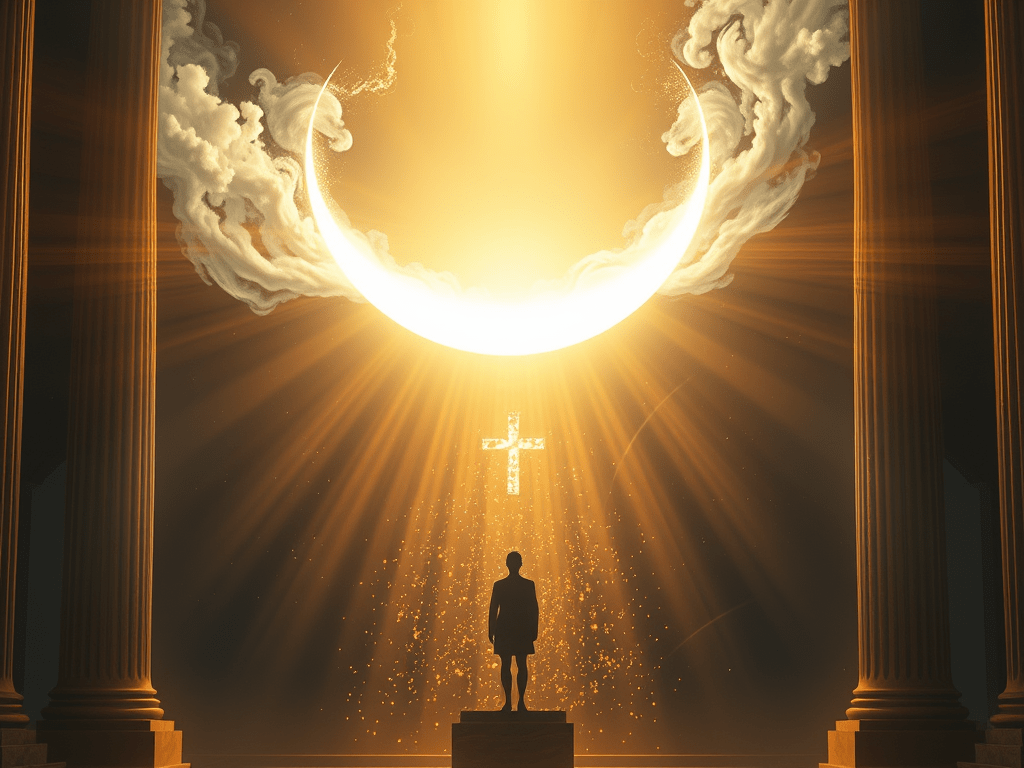
Possiamo immaginare il Punto Zero come una “mezzaluna di luce” o consapevolezza, posta tra il mondo esterno e quello interno. È un luogo di silenzio e presenza in cui tutto appare, “quello che si accende al mattino e si spegne la sera”, dove la nostra esperienza diretta accade.
La dimensione cattolica
Da una prospettiva cattolica, il Punto Zero corrisponde al “cuore” profondo della tradizione spirituale: il luogo sacro in cui siamo in contatto con la nostra vera natura e dove Dio può parlare.
Questo spazio si trasforma in una “cattedrale immensa, silenziosa, luminosa” o in un “telefono diretto con il Creatore”. Riconoscerlo è come un “ritorno a casa”, un “luogo” interiore da ricordare e abitare.
ENGLISH
Losing Oneself
In the previous article, I emphasized again how important it is to “feel” thirst as a necessary condition for embarking on a fruitful spiritual journey.
However, there is another fundamental condition that must be brought into focus, even if not necessarily fully achieved from the beginning: the abandonment of the Ego.
The Nature of the Ego
The Ego is indeed the result of a distorted vision of what we truly are, an illusory narrative that, however, shouldn’t be simply “corrected.” The Ego represents a cultural artifact born from the development of self-awareness in human beings.
Humanity began to “perceive itself” as a separate individual and concluded that it was alone, confined within its body and brain, immersed in a world it perceives as external and internal. This vision should not be corrected, but completely abandoned.
It is self-evident to everyone that “we are,” but we have thought of “being something” without ever truly finding what. We say we are Mario or Carla, but this is an approximation more false than true. Mario is not his body, Carla is not her thoughts: both are what perceives that body and those thoughts.
The Christian-Catholic Path
As I have openly declared multiple times, my path is a Christian-Catholic spiritual journey. On this path, one cannot even think of starting while carrying the Ego. In this sense, one must die to oneself.
Testimonies from Tradition
Scripture and the Church Fathers are unanimous on this point:
From the Scriptures:
- “Unless a grain of wheat falls to the ground and dies, it remains only a single seed; but if it dies, it produces many seeds. Whoever loves their life will lose it, but whoever hates their life in this world will keep it for eternal life.” (John 12:24-25)
- “If anyone wishes to come after me, he must deny himself and take up his cross daily and follow me.” (Luke 9:23)
From the Desert Fathers:
- Abba Anthony: “He who has not renounced all cannot be a disciple of Christ”
- Abba Arsenius: “Die to the world that the world may die in you”
- Abba Macarius: “The soul must die to all visible things to live in the invisible ones.”
From Great Spiritual Masters:
- Saint Bonaventure in his Itinerarium mentis in Deum describes mystical death as a necessary passage towards union with God.
- Saint Francis of Assisi: in “Perfecta laetitia” he shows how perfect joy arises from dying to all forms of self-love.
- Saint Francis de Sales: “We must die to ourselves in a thousand ways every day” (Introduction to the Devout Life)
- Saint Symeon the New Theologian: “He who does not die daily cannot rise daily”
The Zero Point: Beyond the Ego
This passage is not easy to accomplish, and one tends to easily fall back into the Ego. For this reason, I have identified what I call “The Zero Point,” the fundamental place where the Ego practically has no dominion.
What is the Zero Point
The Zero Point is the inner space of pure consciousness. It is not a physical place to reach, but a reinterpretation of “where” our life and every one of our experiences truly manifest.
It is the intermediate state between the external world (body, matter) and the internal world (mind, unconscious, memory). In this space, everything we perceive — sounds, colors, thoughts, emotions — manifests and translates into “experience.”
The True Nature of the Self
At the Zero Point, we are not what we see, hear, or think, but what is aware of all this: the pure witness, the “sensing” and not the “sensed.” Its true nature is freedom itself, which yearns for something that we can never fully experience through the objects of experience.
This consciousness in itself has no name, sex, age, or personal history: these are merely labels or fragments of a narrative that we superimpose upon it.
An Image to Understand It
We can imagine the Zero Point as a “crescent of light” or awareness, placed between the external and internal worlds. It is a place of silence and presence where everything appears, “what lights up in the morning and goes out in the evening,” where our direct experience happens.
The Catholic Dimension
From a Catholic perspective, the Zero Point corresponds to the deep “heart” of spiritual tradition: the sacred place where we are in contact with our true nature and where God can speak.
This space transforms into an “immense, silent, luminous cathedral” or a “direct telephone to the Creator.” Recognizing it is like a ” homecoming,” an inner “place” to remember and inhabit.
 Alberto Giordano Verso
Lascia un commento