I due movimenti verso il Punto Zero
Riassunto puntate precedenti:
Chiacchierata su questo articolo:
Introduzione
Esiste una dimensione della nostra esperienza che spesso trascuriamo: uno spazio interiore dove la vita si manifesta nella sua essenza più pura. È quello che chiamo il Punto Zero, e raggiungerlo richiede due movimenti fondamentali che possono trasformare radicalmente il nostro modo di vivere.
Cos’è il Punto Zero
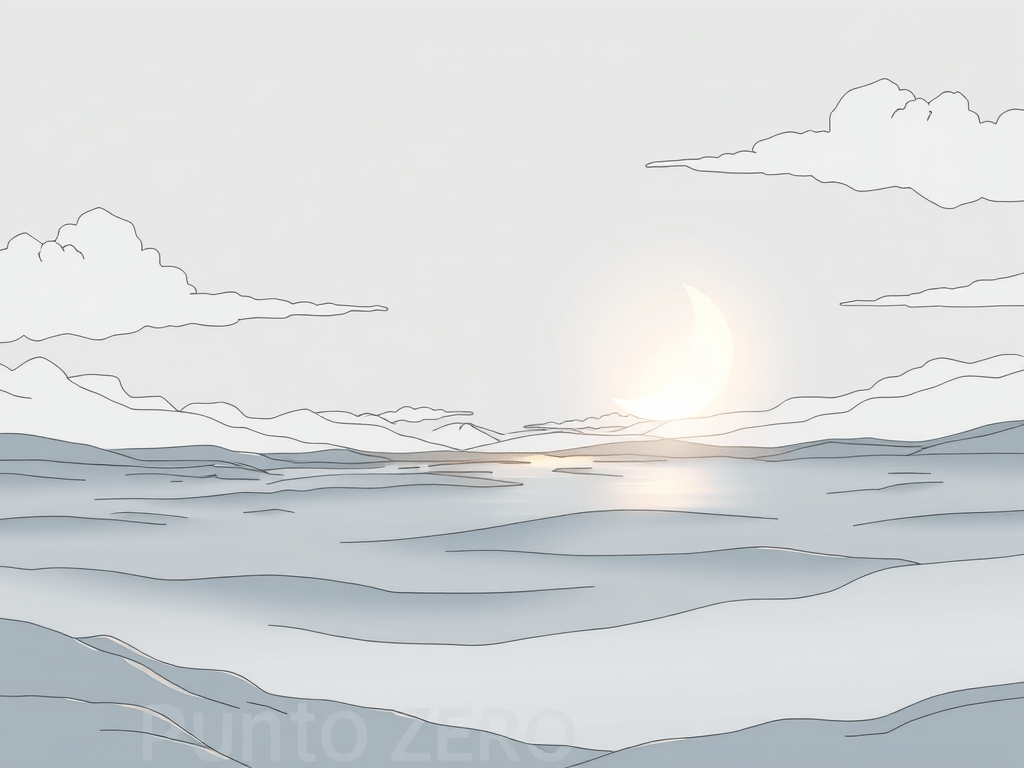
Il Punto Zero non è un luogo fisico da raggiungere, ma una reinterpretazione dello spazio interiore dove ogni nostra esperienza prende forma. È lo stato intermedio tra il mondo esterno e quello interno: una “mezzaluna di luce” abitata dalla coscienza pura.
In questo spazio, non siamo ciò che percepiamo – suoni, colori, pensieri, emozioni – ma ciò che è consapevole di tutto questo. Siamo il puro testimone, il “sentire” e non il “sentito”. La nostra vera natura qui è la libertà assoluta, senza nome, sesso o storia personale.
Nella tradizione cattolica, questo Punto Zero corrisponde al “cuore” profondo dove Dio può parlare: una “cattedrale immensa, silenziosa, luminosa” o un “telefono diretto con il Creatore”. Avvicinarvisi è un “ritorno a casa” che richiede di fare un passo indietro senza muoversi.
Il problema della visione limitata
La nostra comprensione abituale della realtà riconosce solo due mondi:
- Il mondo esterno, fatto di oggetti materiali
- Il mondo interno, fatto di pensieri ed emozioni
Questa visione crea confusione. Il nostro corpo, per esempio, sembra appartenere a entrambi: la pelle è contemporaneamente dentro e fuori di noi. Ma questa prospettiva è fallace perché ignora una dimensione essenziale.
Il primo movimento: riconoscere la coscienza
Il primo passo verso una nuova comprensione è riconoscere che esiste una coscienza che fa esperienza delle cose provenienti da questi due mondi senza essere davvero parte di nessuno dei due.
Questa coscienza:
- Non è fatta degli oggetti dei sensi, benché li percepisca
- Non è fatta dei pensieri che vanno e vengono, benché li osservi
- È il nostro sancta sanctorum, il luogo dove più di ogni altro possiamo dire di “essere”
Possiamo avere un nome diverso, trovarci a Parigi o a New York, essere immersi in un libro o in un sogno. L’unica cosa davvero certa è che siamo quella coscienza che percepisce, che fa esperienza.
Il secondo movimento: scoprire la sete spirituale
All’interno della coscienza troviamo un elemento “alieno” rispetto ai due mondi precedenti: la sete di pace, libertà e piena soddisfazione. Questa sete non si placa con pensieri o emozioni, non si risolve cambiando partner o lavoro.
È una sete di senso che sembra destinata a rimanere insoddisfatta se ci limitiamo ai soli due mondi della visione tradizionale. Ma proprio questa sete è la chiave per scoprire l’esistenza di un terzo mondo: quello spirituale.
La sete di senso rimanda a un tipo di “acqua” che deve possedere un’altra natura. È quello che definisco “l’impronta di Dio” – una chiamata così forte che sentiamo che ci mancherà sempre qualcosa se ci dedichiamo solo ai mondi esterno e interno.
Dal vedere al credere
Qui avviene il passaggio cruciale: dobbiamo passare dal “vedere per credere” al “credere per vedere”.
Quando siamo persi e assetati in un deserto, l’unico modo per non cadere vittime della disperazione è credere che sia possibile raggiungere l’acqua e mettersi in cammino. Nessuno si aspetta di avere la dimostrazione scientifica che l’acqua esista prima di iniziare il viaggio.
Nel cammino spirituale cristiano-cattolico, c’è la fiducia che altri prima di noi abbiano fatto lo stesso percorso e si siano dissetati. C’è la fiducia che le parole del Cristo siano vere. Altri cammini spirituali hanno presupposti diversi, ma il principio rimane: bisogna “credere” per poi “vedere”.
I due movimenti essenziali
Per riscrivere la nostra narrazione esistenziale, dobbiamo compiere questi due movimenti fondamentali:
- La riduzione: purificare la comprensione di ciò che siamo realmente, arrivando al Punto Zero attraverso il riconoscimento della coscienza pura
- La fiducia: scoprire la nostra fiducia nell’esistenza dell’”acqua” spirituale che corrisponde alla sete di senso che conosciamo bene
Conclusione
Avere sete di senso a partire dal Punto Zero ci apre al mondo della spiritualità. Questi due movimenti – il passo indietro verso la coscienza pura e il riconoscimento della dimensione spirituale – ci permettono di trovare quell’equilibrio e quella pace duratura che i soli mondi esterno e interno non possono offrire.
Il Punto Zero è l’unico “luogo” dove possiamo trovare una vera equidistanza tra i mondi che “invadono” la nostra coscienza, e da lì iniziare un cammino autentico verso la realizzazione spirituale.
ENGLISH
The Two Movements
I’ll never tire of saying it: it’s essential for each of us to regain the ability to return to Zero Point. Here, for convenience, is a brief description.
Zero Point is a fundamental concept in the spiritual perspective. I describe it not as a physical place to reach, but as a reinterpretation of the inner space in which our life and every experience manifest. It’s the intermediate state between the external world and the internal world, a “crescent of light” or consciousness, inhabited by consciousness, where experiences converge and translate into “experience.” In this space, the individual is not what they perceive (sounds, colors, thoughts, emotions), but that which is aware of all this: the pure witness, the “feeling” not the “felt.” Its true nature is freedom, without name, gender, or personal history.
Zero Point is the privileged space to connect with a “third world,” the spiritual one, which goes beyond the two ordinary worlds (external and internal). Recognizing it is essential for a new narrative of life and for metanoia (a radical transformation of how we see and live reality), as it allows us to understand that the “thirst” for lasting peace, freedom, and happiness, often unsatisfied by the other two worlds, is a compass pointing to the existence of this spiritual dimension and the possibility of satisfying it.
In the Catholic view, in my opinion, this Zero Point is the “heart,” the deep place where God can speak, an “immense, silent, luminous cathedral” or a “direct telephone to the Creator.” Approaching it is a ” homecoming” that requires taking a step back without moving, recognizing that every experience manifests in the “here and now” of consciousness.
Our Zero Point is the only “place” where it’s possible to find balance, an equidistance between the worlds that “invade” our consciousness. A hasty and imprecise view of life leads us to consider the existence of only two worlds: the external world, made of material objects, and the internal one, made of mental and emotional objects.
In reality, our body is something that belongs to both worlds, a very subtle line, so subtle that it’s almost impossible to identify. Our skin, for example, is simultaneously inside and outside of us, according to this fallacious view.
Our new narrative, which includes a spiritual vision, can only start from a new assumption, a new premise: that there exists a consciousness that experiences things coming from these two apparent worlds without truly being “part” of either.
It is not made of the objects of the senses, though it perceives them; nor is it made of thoughts, which come and go, though it perceives them.
Within consciousness there is then an “alien” object, extraneous to the two previously described worlds: the thirst for peace, freedom, complete satisfaction. This thirst is not quenched by thoughts or emotions, nor by changing partners or jobs. It’s a thirst for meaning that is seemingly destined never to be satisfied.
Here the second revolution occurs: the thirst for meaning refers to a type of water that must possess another nature. It belongs to a third world, a world we call spiritual.
Here is the second revolution that helps us rewrite our narrative.
First, we must distance ourselves from the outer and inner worlds (which in the previous narrative are the only ones existing), only to realize that Zero Point exists, the place of “feeling,” the place where worlds are perceived. That place is our sanctum sanctorum, the place where, more than anywhere else, we can say we “are.”
We can have one name or another, one thought or another; we can walk on the soil of Paris or New York, we can be immersed in a book or a dream. It doesn’t matter: the only truly certain thing is that we are that consciousness that perceives things, that which experiences, even if it truly has no name, gender, or any other belonging to the external or internal world.
Secondly, we then realize that there are “objects” of perception that do not come only from outside or inside.
These are the two main movements that allow us to rewrite our narrative: taking a step back from the only two apparent worlds and realizing that among the objects we perceive there is at least a third world, more elusive, less obvious, but which influences us greatly, which calls us.
It calls us to such an extent that we feel something will always be missing if we dedicate ourselves only to the two worlds of the old narrative.
I have defined thirst, which produces suffering if not listened to, as the imprint of God.
Now, this may seem like a significant logical leap.
Someone might say that thirst perhaps exists as an “evolutionary error” or simply is there never to be satisfied, so much so that nothing seems capable of doing so.
Here it’s important to shift from a vision that evolves from “seeing” (thirst) to believe, to “believing” (that thirst exists because water exists) to “see” the spiritual world.
There’s no other way.
If you are lost and thirsty in a desert, the only way not to fall victim to despair is to “believe” that it’s possible to reach water and set out.
No one expects to have scientific proof that water exists before setting out; the call is enough.
For the spiritual path, it’s the same thing. In the Christian-Catholic spiritual journey, there is trust that others before us have done the same and quenched their thirst; there is trust that the words of Christ are true.
Obviously, every other spiritual path has other presuppositions to “believe” in; but the essence remains the same: to “see,” otherwise everything will be useless.
If, as we embark, we don’t start “seeing” something, then it’s normal to begin questioning the correctness of the chosen path.
In my opinion, it remains fundamental to have made these two movements: the reduction, the purification of what we truly are (reaching Zero Point) in one of the thousand possible ways, and then having discovered our trust in the existence of water that counteracts the thirst we know very well.
Having a thirst for meaning, starting from Zero Point, opens us to the world of spirituality.
 Alberto Giordano Verso
Lascia un commento